The March birth flower is the daffodil (Narcissus pseudonarcissus) — and the jonquil (Narcissus jonquilla). Both belong to the genus Narcissus within the family Amaryllidaceae.
They are botanically related but symbolically, visually, and aromatically distinct. Choosing between them for a gift, tattoo, or personal emblem requires understanding those differences precisely.
| Feature | Daffodil | Jonquil |
|---|---|---|
| Botanical name | Narcissus pseudonarcissus | Narcissus jonquilla |
| Blooms per stem | 1 | 2–6 (clustered) |
| Leaf shape | Flat, sword-like | Narrow, cylindrical, rush-like |
| Fragrance | Mild to absent | Powerfully fragrant |
| Primary symbolism | New beginnings, rebirth, hope | Affection, desire, domestic happiness |
| Zodiac alignment | Aries (March 21–April 19) | Pisces (February 19–March 20) |
| USDA hardiness zones | 3–8 | 5–9 |
| Toxic to pets | Yes — all parts | Yes — all parts |
| Gifting context | Bold gesture, celebration, cheer | Intimate, romantic, emotionally resonant |
| Birthstone pairing | Aquamarine, Bloodstone | Aquamarine, Bloodstone |
This page covers: the botanical difference between the daffodil and jonquil, what each flower symbolises, how to select the right one by zodiac and personality, cultural meanings across Wales, China, Japan, and Greece, the jonquil’s status in high-end perfumery, growing instructions, pet safety, and a complete gift guide.
Table of Contents
What Is the March Birth Flower?
March has two official birth flowers: the daffodil and the jonquil. Both are members of the Narcissus genus. The widespread confusion between them — and between both and the word “narcissus” — stems from overlapping common names that have been used inconsistently across centuries of horticultural literature.
The naming hierarchy works as follows:
- Narcissus is the botanical genus containing over 50 species and approximately 27,000 registered cultivars (Royal Horticultural Society, 2023). It is the correct scientific umbrella term.
- Daffodil is the accepted common name for all plants in the Narcissus genus in the United Kingdom, the United States, and most English-speaking countries. Every plant in the genus is correctly called a daffodil.
- Jonquil is the common name for Narcissus jonquilla, specifically, one species within the genus, distinguished by its fragrance, clustered blooms, and cylindrical foliage.
The single rule that resolves the confusion: all jonquils are daffodils, but not all daffodils are jonquils.
In the American South, “jonquil” is used colloquially to refer to any yellow daffodil, regardless of species. This regional usage is botanically imprecise. The American Daffodil Society (ADS) classifies Narcissus into 13 divisions; jonquils fall under Division 7 (Jonquilla daffodils).
Is Cherry Blossom a March Birth Flower?
Cherry blossom (Prunus serrulata) is not part of the traditional Western birth flower canon for March. The daffodil and jonquil are the historically recognised March birth flowers in British and American floriography traditions.
Cherry blossom appears on numerous contemporary birth flower lists for March because its bloom window in Japan and Korea (typically late March through early April) coincides with the month. Social media platforms, particularly Pinterest and TikTok, have propagated this association widely.
Its inclusion is a modern, regionally influenced adaptation — not an error, but a departure from the established Western tradition. Content that lists cherry blossom as an equal alternative to the daffodil without this context is imprecise.
Daffodil vs. Jonquil: The Botanical Breakdown
The Definitive Comparison
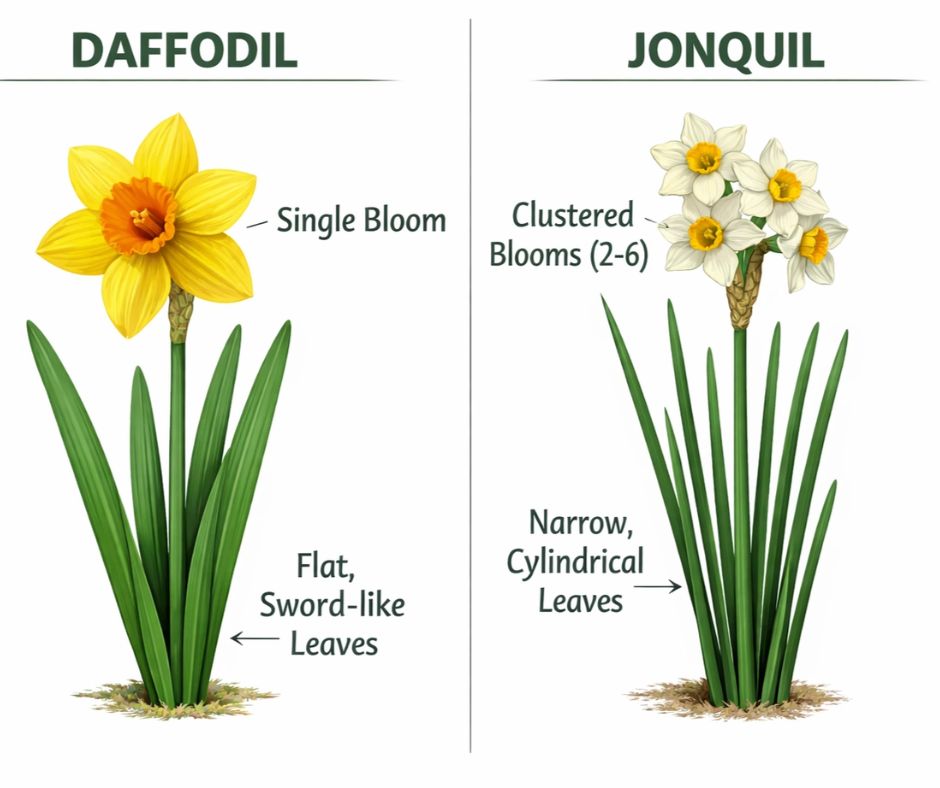
The daffodil and jonquil differ in five measurable botanical characteristics: bloom count per stem, leaf morphology, fragrance intensity, bloom timing, and cold hardiness.
| Botanical Feature | Daffodil (Narcissus genus) | Jonquil (Narcissus jonquilla) |
|---|---|---|
| Flowers per stem | 1 (occasionally 2 in some cultivars) | 2–6, in terminal clusters |
| Leaf cross-section | Flat, strap-like, 10–35 mm wide | Cylindrical, hollow, rush-like, 2–4 mm wide |
| Leaf colour | Grey-green to mid-green | Dark green |
| Fragrance | Mild; absent in many cultivars | Strong; sweet, warm, slightly green |
| Bloom period | Late February – April (zone-dependent) | March – May (slightly later than large-cupped types) |
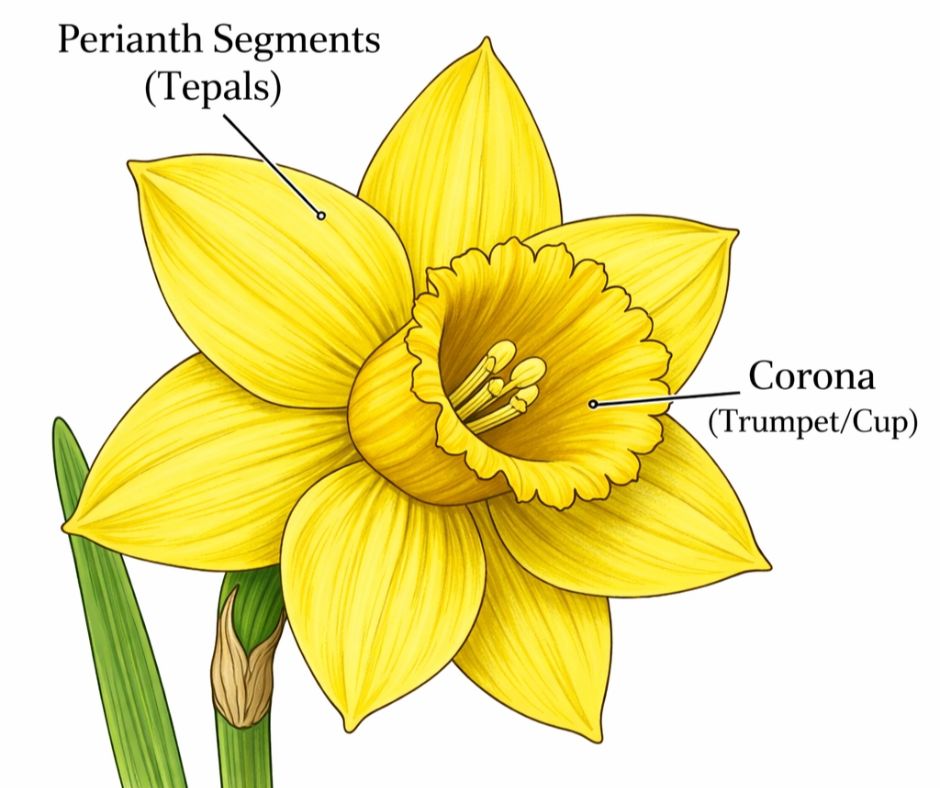
| Flower size | Large; corona (trumpet) 20–100 mm | Small; corona 3–10 mm |
| Perianth segments (tepals) | 6; white to yellow to orange | 6; typically yellow to cream |
| USDA cold hardiness | Zones 3–8 | Zones 5–9 (less cold-tolerant) |
| Height | 20–50 cm (8–20 inches) | 20–35 cm (8–14 inches) |
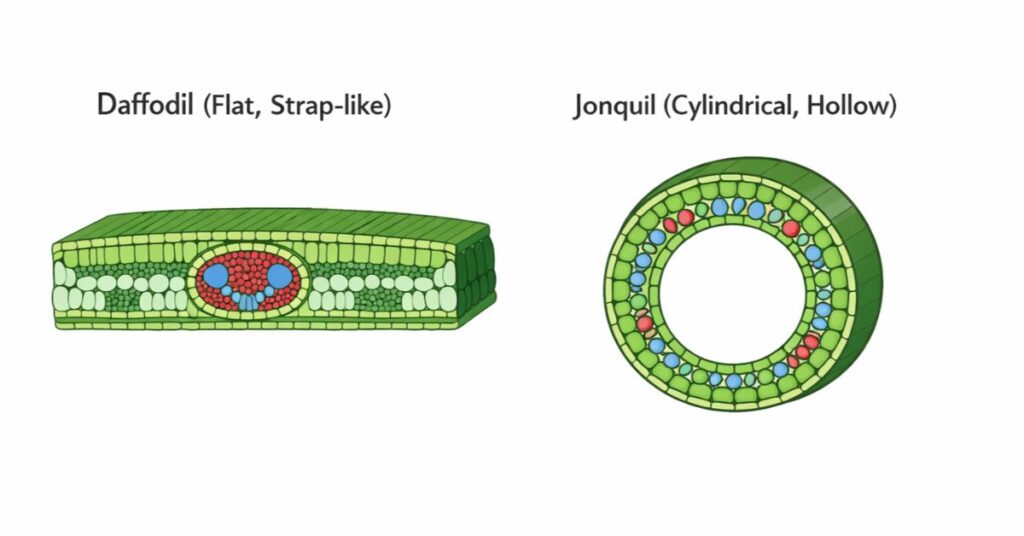
The leaf shape is the fastest field identification method. Holding a leaf cross-section: a flat, ribbon-like leaf belongs to a standard daffodil; a round, hollow stem — resembling a rush or thin reed — belongs to a jonquil.
The word “jonquil” derives from the Spanish junquillo, meaning “little rush,” a reference to this foliage.
The Jonquil in High-End Perfumery
Jonquil absolute (extrait de jonquille) is one of the most expensive and rarest botanical extracts used in modern perfumery. The fragrance compounds are primarily extracted from Narcissus jonquilla and Narcissus tazetta using solvent extraction or enfleurage, yielding a complex scent profile that perfumers describe as simultaneously floral, green, earthy, and slightly animalic.
A kilogram of jonquil absolute requires approximately 500 kilograms of flowers to produce. Grasse, the historical centre of French perfumery, has cultivated Narcissus for fragrance extraction since the 17th century.
Jonquil absolute appears in the composition of several significant commercial fragrances; it belongs to the same olfactory family as tuberose and hyacinth absolutes — natural materials that are used in milligram quantities per kilogram of finished fragrance due to cost and intensity.
This scent complexity distinguishes a jonquil bouquet from a standard daffodil arrangement in a way that is immediately perceptible. A vase of jonquils will fragrance a medium-sized room; a vase of standard trumpet daffodils will not.
March Birth Flower Meaning and Symbolism
What the Daffodil Symbolises
The daffodil’s primary symbolic meanings are new beginnings, hope, rebirth, and the renewal of the creative spirit.
These meanings are grounded in its phenological behaviour: the daffodil is one of the first flowers to emerge from frozen ground in late winter, often blooming before the last frost. Its appearance marks the end of winter’s dormancy.
In Victorian floriography — the systematic language of flowers codified in the 19th century — the daffodil carried the meaning of chivalry and regard.
The gifting rule that persists from this tradition is precise: a bunch of daffodils signals joy, good fortune, and celebration; a single daffodil traditionally signals misfortune.
This is not an urban myth — it appears in multiple Victorian floral dictionaries, including Flora’s Dictionary by Elizabeth Gamble Wirt (1829). Always gift daffodils in multiples.
Additional meanings assigned to the daffodil across different traditions include:
- Forgiveness and reconciliation: a gesture of willingness to start over
- Creativity and inspiration: associated in Romantic literature with the awakening of artistic perception
- Unrequited love (specifically in its narcissus mythological context): longing for affection that cannot be returned
The American Cancer Society adopted the daffodil as its symbol of hope for cancer patients in the 1970s. Its annual Daffodil Days campaign, run each March, has distributed daffodil pins and fresh flowers to cancer patients across North America for over four decades.
This charitable association reinforces the daffodil’s meaning as a symbol of endurance and hope under difficult circumstances.
What the Jonquil Symbolises
The jonquil’s primary symbolic meanings are affection, desire, resilience, and domestic happiness. In Victorian floriography, the jonquil carried the specific meaning: I desire a return of affection — a nuanced expression of longing for reciprocated love, distinct from the broader hope of the daffodil.
The jonquil’s secondary symbolic dimensions include:
- Resilience beneath delicacy: the jonquil’s small, fragile appearance contrasts with its intense fragrance and its capacity to naturalise and spread in difficult conditions
- Empathy and close emotional bonds: the clustering habit of the jonquil’s blooms has been interpreted in the language of flowers as representing closeness and mutual warmth
- Sincerity: white jonquil cultivars carry associations of honest communication and genuine feeling
The distinction between daffodil and jonquil symbolism has practical gifting implications. A daffodil arrangement is appropriate for birthdays, celebrations, and gestures of general goodwill. A jonquil arrangement is more appropriate for romantic gifting, expressions of deep personal affection, or acknowledgment of intimate bonds.
The Narcissus Myth: Origin of the Name
The genus name Narcissus originates in Greek mythology from the story of Narcissus (Νάρκισσος), a youth of extraordinary beauty who, according to Ovid’s Metamorphoses (Book III, written approximately 8 CE), fell in love with his own reflection in a pool and wasted away, unable to leave it.
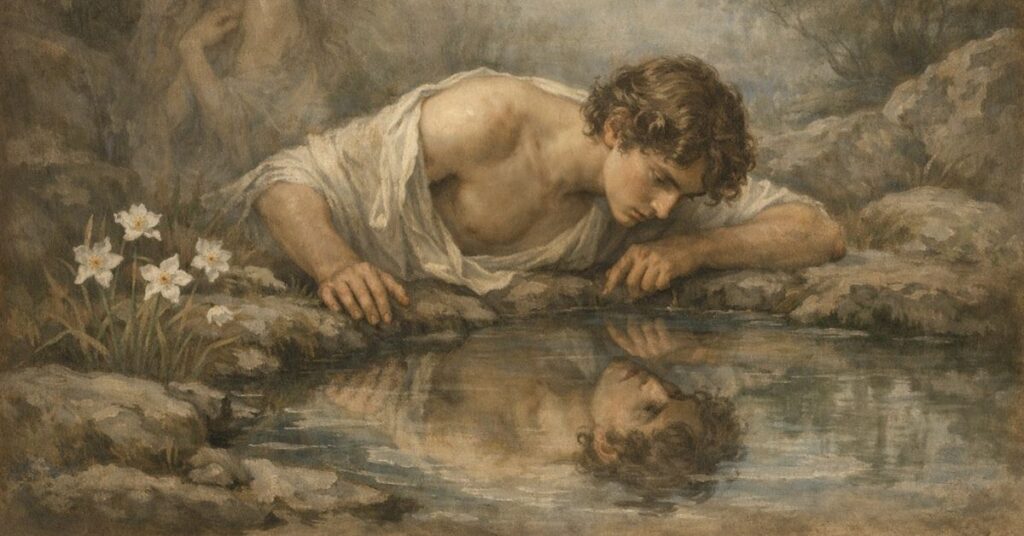
The nymph Echo, condemned by Hera to repeat only the final words of others, loved Narcissus and wasted away equally when her love was not returned — leaving only her voice. From the place where Narcissus died, the narcissus flower grew.
Contemporary scholarly interpretation of the myth emphasises not vanity but the inability to receive love — Narcissus’s tragedy is that he cannot connect with anything outside himself. This reading is relevant to the flower’s symbolic meaning: the narcissus represents the cost of self-enclosure and the necessity of reciprocity in affection.
The word narcissism entered the English language through this myth. The narcissus flower, however, is not culturally associated with self-obsession in gifting or floriography contexts — its symbolic meanings in that tradition (hope, rebirth, affection) are entirely positive.
March Birth Flower by Zodiac: Pisces and Aries
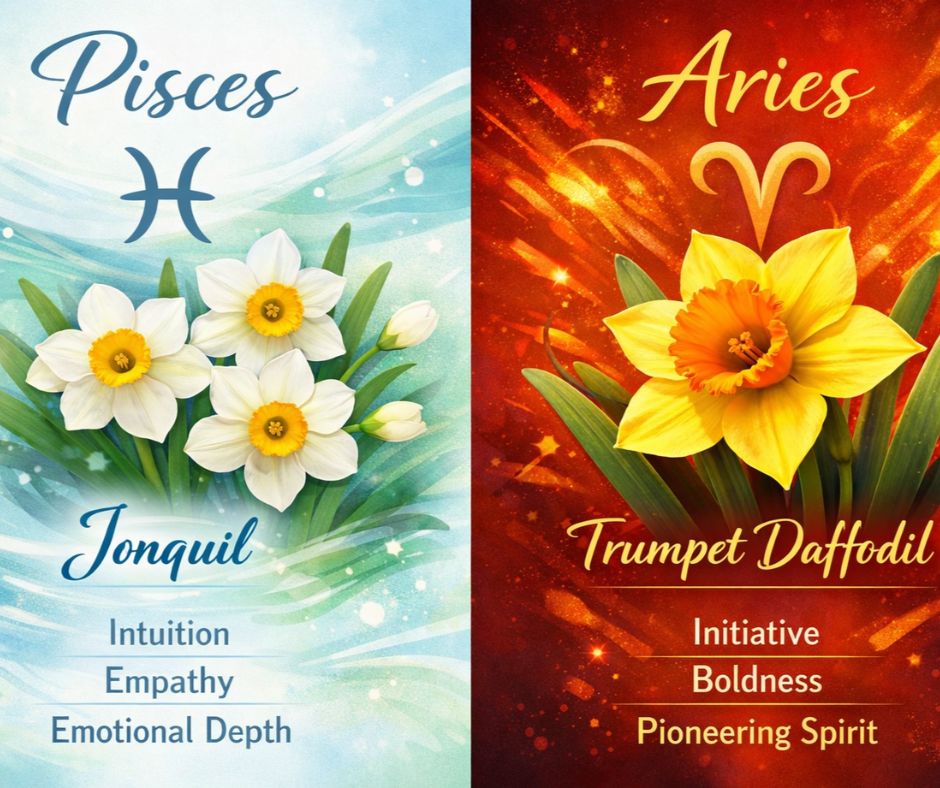
The Pisces Birth Flower (February 19 – March 20)
The jonquil (Narcissus jonquilla) is the birth flower most precisely aligned with Pisces. Pisces is the 12th and final sign of the zodiac, ruled in modern astrology by Neptune and in traditional astrology by Jupiter. It is a mutable water sign characterised in astrological literature by emotional depth, intuition, empathy, and creative sensitivity.
The correspondences between Pisces and the jonquil are as follows:
- The jonquil’s association with deep affection and desire (I desire a return of affection) reflects Pisces’ orientation toward emotional intimacy and yearning
- The jonquil’s strength beneath its delicate appearance mirrors the Pisces quality of resilience concealed beneath sensitivity
- The jonquil’s powerful fragrance — a hidden intensity not apparent from its small form — parallels the Piscean characteristic of containing more depth than surface appearance suggests
- Both Pisces and the jonquil are associated with endings and transitions: Pisces is the last sign before the zodiacal new year; the jonquil blooms as winter finally releases its hold
The Aries Birth Flower (March 21 – April 19)
The trumpet daffodil is the birth flower most precisely aligned with Aries. Aries is the 1st sign of the zodiac, ruled by Mars. It is a cardinal fire sign characterised in astrological literature by initiative, boldness, directness, and pioneering energy.
The correspondences between Aries and the trumpet daffodil are as follows:
- The trumpet daffodil is among the first flowers to emerge in spring — it does not wait for conditions to be comfortable before blooming, a behaviour that directly mirrors Aries’ first-mover quality
- The daffodil’s bold, single trumpet bloom — large, upright, and impossible to overlook — matches Aries’ directness and visibility
- The daffodil’s primary meaning of new beginnings aligns with Aries’ position as the first sign, representing the start of the astrological year
- Both the daffodil and Aries are defined by immediacy: one forces through frozen ground; the other acts before deliberation
Practical Gifting Application by Zodiac
| March Birthday | Zodiac | Recommended Flower | Supporting Meaning |
|---|---|---|---|
| February 19 – March 20 | Pisces | Jonquil | Affection, depth, resilience beneath delicacy |
| March 21 – March 31 | Aries (early) | Trumpet daffodil | New beginnings, bold energy, pioneering spirit |
This distinction is useful for personalised gifting. A jonquil arrangement for a Pisces birthday communicates awareness of the recipient’s emotional character. A bold trumpet daffodil arrangement for an Aries birthday communicates recognition of their energy and initiative.
Daffodil and Jonquil Colour Meanings
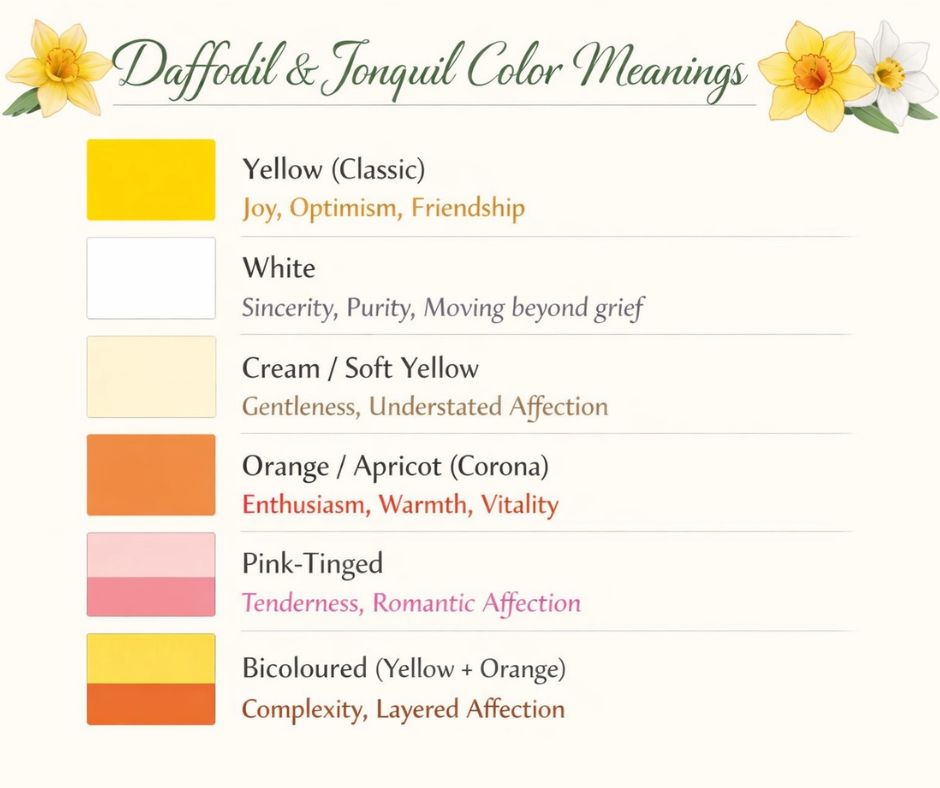
The colour of the daffodil or jonquil selected modifies the flower’s symbolic meaning. The base symbolism (hope, rebirth, affection) remains constant; colour adds a layer of specificity.
| Colour | Symbolic Meaning | Gifting Context |
|---|---|---|
| Yellow (classic) | Joy, optimism, friendship, energy | Celebrations, birthdays, get-well gestures |
| White | Sincerity, purity, moving beyond grief | Memorial gestures, new beginnings after loss |
| Cream / soft yellow | Gentleness, understated affection | Intimate gifting, quiet acknowledgment |
| Orange / apricot (corona) | Enthusiasm, warmth, vitality | Energetic celebration; milestone birthdays |
| Pink-tinged (e.g., ‘Pink Charm’) | Tenderness, romantic affection | Romantic gifting; softer expression of care |
| Bicoloured (e.g., yellow + orange) | Complexity, layered affection | Multi-dimensional relationships; long friendships |
Orange and apricot corona daffodils — including cultivars such as ‘Red Devon’, ‘Jetfire’, and ‘Professor Einstein’ — have seen increased demand in the premium cut flower market.
‘Red Devon’, registered with the ADS, produces a white perianth with a deep orange-red corona and has become a reference cultivar for this colour category.
The March Birth Flower in Global Culture
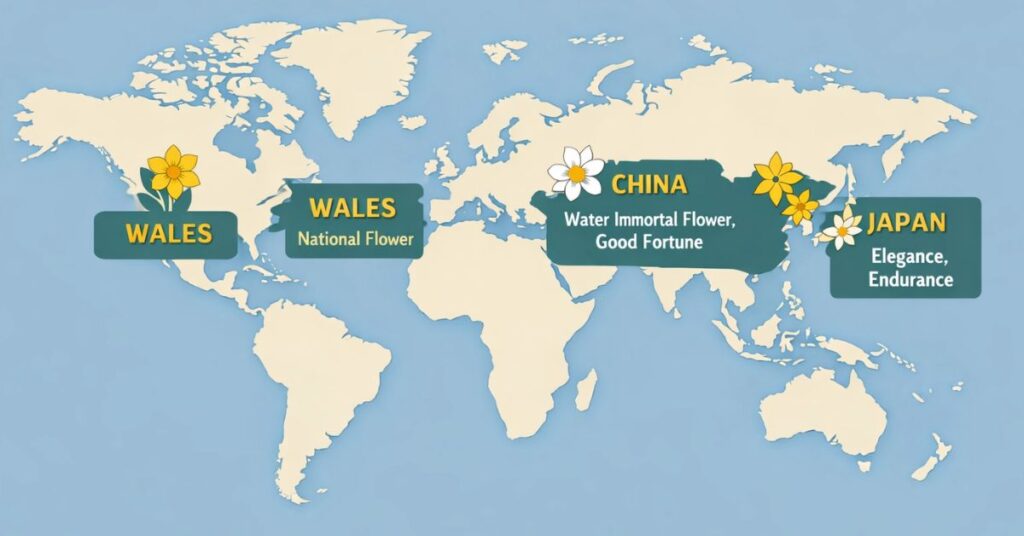
Wales: The National Flower
The daffodil is one of the two national symbols of Wales — the other being the leek — and is worn on St. David’s Day, Monday, March 1, the national day of Wales. In Welsh, the daffodil is called cenhinen Bedr (Peter’s leek), a name that reflects the historical conflation between the two symbols.
The daffodil’s association with Wales became dominant in the 19th century, partly through the influence of Prime Minister David Lloyd George, who favoured the daffodil over the leek as a more visually appealing national symbol at public ceremonies. Welsh national sports teams — including the Welsh Rugby Union — incorporate the daffodil into kit and emblem designs.
St. David’s Day falls on the first day of March, making it the calendrical opening of the March birth flower season in the Northern Hemisphere.
China: The Water Immortal Flower
In Chinese culture, the narcissus (水仙花, shuǐxiān huā, meaning “water immortal flower”) is a symbol of good fortune, prosperity, and the Lunar New Year. Forced narcissus bulbs are traditionally grown to bloom during the Chinese New Year period — timed by careful refrigeration and forcing schedules to achieve bloom at the correct moment.
The practice of presenting a blooming narcissus as a New Year gift carries wishes for ten thousand years of good fortune (wànnián jíxiáng).
The species most commonly used in this tradition is Narcissus tazetta var. chinensis (Chinese sacred lily), a polyanthus-type narcissus that produces multiple small white flowers with yellow coronas and is intensely fragrant — closer in character to the jonquil than to the large-cupped trumpet daffodil.
Japan: Suisen
In Japan, the narcissus (水仙, suisen) is associated with elegance, respect, and the quiet persistence of beauty in winter. Japanese narcissus (Narcissus tazetta var. orientalis) blooms from December through March, making it a symbol of hope and endurance during the coldest months.
The suisen appears frequently in Japanese art, poetry, and the ikebana (flower arranging) tradition, where its clean lines and minimal form are considered aesthetically distinctive.
Cherry blossom (sakura) dominates Japanese spring imagery from late March through April. The suisen occupies the transitional space before the sakura season — a quieter, more introspective symbol.
The Korean Birth Flower for March
In the Korean birth flower tradition, the March birth flower is forsythia (개나리, gaenari, Forsythia koreana) — not the daffodil. Korea maintains a birth flower calendar entirely distinct from the Western tradition.
Forsythia is a deciduous flowering shrub that blooms across Korea in early spring, typically from late February through April, and is one of the most recognised symbols of the Korean spring. It appears in Korean poetry, song, and visual art as an emblem of anticipation and seasonal renewal.
This distinction is important for content targeting Korean-language or Korean-cultural audiences. A gift framed around the “March birth flower” for a Korean recipient carries a different botanical reference point than the same gift framed for a Western audience.
Literature: Wordsworth’s Daffodils
William Wordsworth’s poem “I Wandered Lonely as a Cloud” (composed 1804, published 1807) is the most widely read English-language literary work featuring the daffodil.
The poem describes a field of daffodils beside Ullswater in the Lake District and closes with the observation that the memory of them functions as emotional sustenance.
Dorothy Wordsworth’s journal entry for Thursday, April 15, 1802, records the original walk that inspired the poem, noting “a long belt” of daffodils along the shore, with “some resting their heads upon these mossy stones.”
The poem fixed the daffodil in British cultural consciousness as a symbol of abundance, natural joy, and the capacity of beauty to restore the mind.
Growing the March Birth Flower
Are Daffodils Perennials?
Yes — both daffodils and jonquils are perennial bulbs that return reliably every year without replanting. They naturalise over time, meaning the bulb clumps divide and multiply, increasing the size of the display with each successive year.
A bulb planted in autumn 2026 can be expected to bloom annually for 10–20 years or longer under appropriate growing conditions.
This is not the case with tulips in many climates. Tulips typically require annual replanting in zones warmer than Zone 6 to maintain reliable bloom; daffodils and jonquils do not.
When to Plant Daffodil and Jonquil Bulbs
Plant daffodil and jonquil bulbs in autumn: September through November in the Northern Hemisphere, and March through May in the Southern Hemisphere. The bulbs require a vernalisation period — a sustained cold period below 9°C (48°F) for a minimum of 13 weeks — to initiate spring blooming.
This cold requirement cannot be bypassed by planting in spring in temperate climates; bulbs planted in March 2026 in the Northern Hemisphere will not bloom until spring 2027 at the earliest.
For a March birthday gift, the practical options are:
- Purchase potted forced daffodil or jonquil bulbs from a garden centre (already vernalised and beginning to shoot)
- Order fresh-cut daffodil or jonquil stems from a florist or online cut flower supplier
- Purchase a gift bulb kit for autumn planting, presented with a card explaining the delayed bloom
Planting Specifications
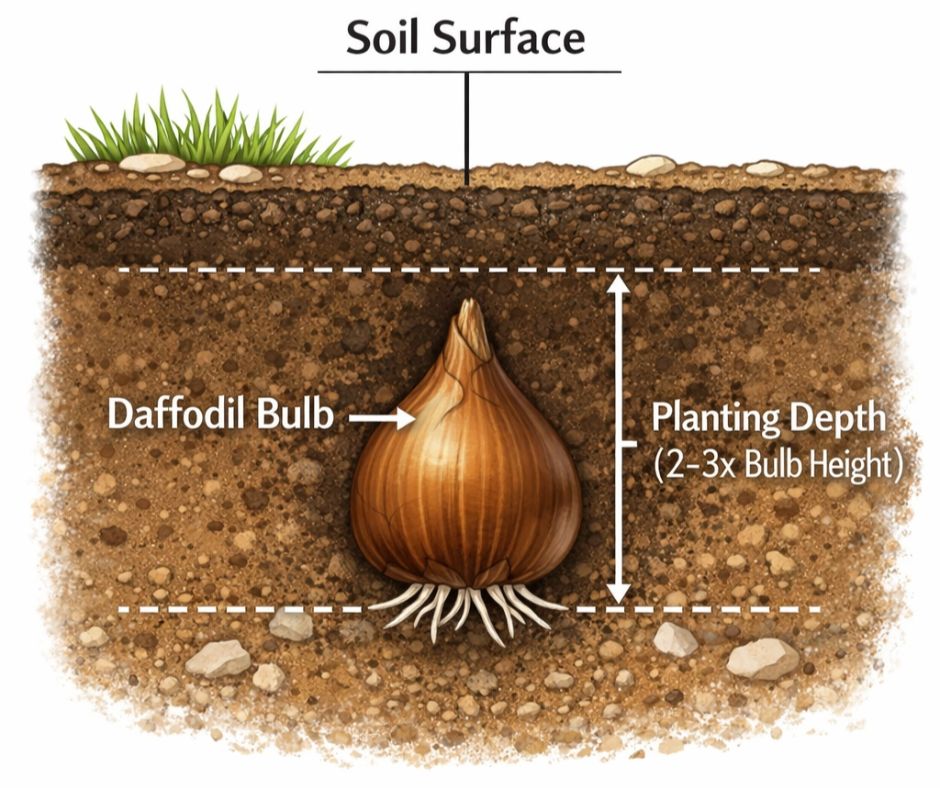
Daffodil and jonquil bulbs require well-draining soil, a minimum of 6 hours of direct sunlight daily, and planting at a depth of 2–3 times the bulb’s height.
| Specification | Daffodil | Jonquil |
|---|---|---|
| Planting depth | 15–20 cm (6–8 inches) | 10–15 cm (4–6 inches) |
| Spacing | 10–15 cm (4–6 inches) apart | 8–12 cm (3–5 inches) apart |
| Soil pH | 6.0–7.0 | 6.0–7.0 |
| Sun requirement | Full sun to partial shade (min. 6 hours) | Full sun to partial shade (min. 6 hours) |
| Soil type | Well-draining; avoid waterlogged ground | Well-draining; tolerates slightly drier conditions |
| USDA hardiness | Zones 3–8 | Zones 5–9 |
| Cold requirement | Min. 13 weeks below 9°C (48°F) | Min. 13 weeks below 9°C (48°F) |
Plant the bulb with the nose (pointed end) facing upward. In containers, bulbs can be planted “shoulder to shoulder” — touching or nearly touching — to create a dense, full display. Containers must have drainage holes; waterlogging at the base of the container causes basal rot within weeks.
Care After Blooming
Do not cut back daffodil or jonquil foliage for a minimum of 6 weeks after the flowers have faded. The leaves photosynthesize and return energy to the bulb, building the reserves required for next year’s bloom. Removing the foliage prematurely produces progressively smaller flowers and eventually prevents blooming altogether.
Correct post-bloom care:
- Deadhead the spent flower head by snapping or cutting the stem just below the flower
- Leave all foliage intact until it has yellowed completely and pulls away from the bulb without resistance
- Apply a balanced bulb fertiliser (such as a 5-10-10 NPK formulation) immediately after flowering
- Reduce watering gradually as the foliage dies back
Braiding or tying back leaves — a common practice intended to neaten the garden — restricts photosynthesis and is not recommended by the Royal Horticultural Society (RHS) or the American Daffodil Society.
Daffodil Safety: Toxicity to Pets and Vase Compatibility
Are Daffodils Toxic to Cats and Dogs?
Yes — all parts of the daffodil and jonquil plant are toxic to cats and dogs. The bulb contains the highest concentration of toxic alkaloids, primarily lycorine and calcium oxalate crystals. Ingestion of the bulb can cause more severe symptoms than ingestion of the flowers or leaves.

Toxicity in Cats
In cats, daffodil ingestion causes vomiting, profuse salivation, lethargy, abdominal pain, and diarrhoea. Severe cases may involve tremors and cardiac arrhythmia.
The ASPCA Animal Poison Control Center lists Narcissus species as toxic to cats. If a cat ingests any part of a daffodil or jonquil, contact a veterinarian or the ASPCA Animal Poison Control Center (888-426-4435) immediately. Do not wait for symptoms to develop.
Toxicity in Dogs
In dogs, symptoms of daffodil poisoning include vomiting, diarrhoea, abdominal pain, drooling, and lethargy. Dogs that dig in gardens are at elevated risk of bulb ingestion. The bulb’s firm texture and distinctive smell may attract foraging dogs. Store unplanted bulbs in sealed containers out of reach.
Safe Spring Alternatives for Pet-Owner Households
For households with cats or dogs where fresh narcissus carries risk, alternative spring flowers with lower toxicity profiles include:
- roses (Rosa spp.),
- snapdragons (Antirrhinum majus),
- sunflowers (Helianthus annuus),
- and orchids (Phalaenopsis spp.).
Confirm the current toxicity status with the ASPCA database before gifting flowers to a household with pets.
The Narcissus Sap Problem: Vase Compatibility
Freshly cut daffodils and jonquils release a latex-like sap containing calcium oxalate crystals and alkaloids that are toxic to other cut flowers placed in the same water. Roses and tulips are particularly susceptible; they will wilt prematurely — often within hours — when placed alongside freshly cut narcissus stems.
This is not a myth or an exaggeration. The phenomenon is well-documented in horticultural literature and is caused by the sap’s interference with the vascular systems of companion flowers.
The conditioning process eliminates this risk:
- Cut daffodil or jonquil stems at a 45-degree angle under running water
- Place them alone in a clean vase filled with fresh, cool water
- Leave them undisturbed for 24 hours in a cool location away from direct sunlight
- After 24 hours, discard the water, rinse the vase thoroughly, refill with fresh water, and the daffodils or jonquils can then be arranged with other flowers safely
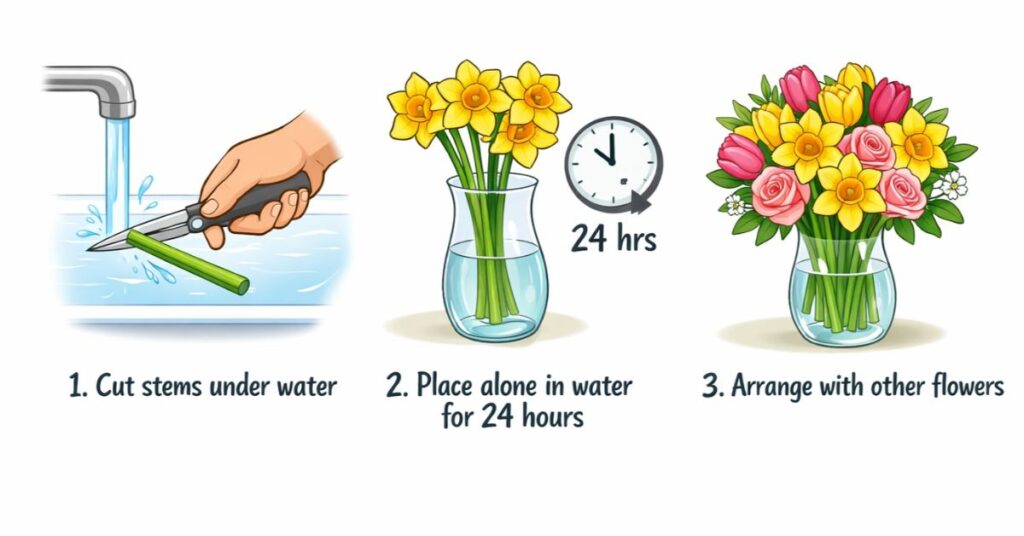
Do not re-cut the stems after conditioning, as this reopens the sap-releasing wound. After conditioning, narcissus stems can be arranged alongside roses, tulips, hyacinths, and other spring flowers without damage.
Gift Guide: March Birth Flower for Every Recipient
Selecting the Right Flower for the Gift
The choice between daffodil and jonquil for a March birth flower gift should be determined by the relationship between giver and recipient, the occasion, and the recipient’s zodiac placement within March.
The following framework applies:
| Recipient Type | Relationship | Occasion | Recommended Flower | Rationale |
|---|---|---|---|---|
| Pisces (Feb 19–Mar 20) | Romantic partner | Birthday, anniversary | Jonquil | Resonates with Piscean emotional depth and the jonquil’s meaning of returned affection |
| Aries (Mar 21–Apr 19) | Friend, colleague | Birthday, milestone | Trumpet daffodil | Bold energy matches Aries’ character; celebratory symbolism |
| Any March birthday | Professional relationship | Birthday acknowledgment | Yellow trumpet daffodil | Unambiguously positive; universally legible symbolism |
| Any March birthday | Parent, grandparent | Birthday | White daffodil bouquet | Sincerity; timeless symbolism without romantic dimension |
| Pet owner | Friend | Birthday | Pressed jonquil art or jonquil-scented candle | Avoids live flower toxicity risk |
March Birth Flower Jewellery
Formats available in the current market include:
- Daffodil pendant necklaces: fine-line or three-dimensional petal rendering in sterling silver, yellow gold, or gold vermeil; aquamarine centre stones align with the March birthstone
- Stackable birth flower rings: thin band with a small daffodil motif; designed to be worn with other birth month rings in a family set
- Daffodil stud earrings: minimalist daily-wear option; more recognisable as a symbol than jonquil studs
- Jonquil cluster earrings: the jonquil’s clustered bloom structure translates well to drop earring formats; more complex and less immediately recognisable than daffodil designs
- Pressed flower resin jewellery: actual daffodil petals preserved in clear resin pendants or rings; a growing category in the handmade jewellery market
When selecting daffodil jewellery, the trumpet corona — the central cup that distinguishes the daffodil from other flowers — should be present and legible in the design. Pieces that omit the corona are often misidentified as generic flower jewellery rather than specifically daffodil jewellery.
Fresh Flower Bouquets
Always gift daffodils or jonquils in a bunch of multiple stems — never as a single stem. The single-daffodil misfortune association from Victorian floriography remains widely circulated. A standard bouquet of 10–12 stems is the conventional gifting quantity.
Seasonal companion flowers that pair well with daffodils after the 24-hour conditioning period include:
- White tulips (Tulipa spp.) — same bloom season; clean contrast
- Hyacinths (Hyacinthus orientalis) — complementary fragrance; blue-purple colour contrast
- Pussy willow (Salix caprea) branches — structural element; extends the vase life of the arrangement visually
- Grape hyacinth (Muscari armeniacum) — small scale; provides colour depth
Jonquil bouquets should be presented in small, compact arrangements to allow the fragrance — the flower’s primary aesthetic quality — to concentrate.
Garden Gifts
For a March birthday recipient who gardens, a kit of Narcissus jonquilla bulbs (specifically the cultivar ‘Trevithian’, ‘Baby Moon’, or ‘Pipit’) for autumn 2026 planting represents a gift with an approximate 3–4 week bloom window in spring 2027.
‘Trevithian’ produces up to 3 strongly fragrant yellow flowers per stem and is consistently rated among the most fragrant jonquil cultivars by the ADS. ‘Baby Moon’ is a miniature jonquil growing to 25 cm with pale yellow flowers, suited to rockeries and containers.
For daffodil cultivars as gifts, the following are ADS Award of Merit recipients: ‘Ice Follies’ (large white perianth, cream corona; Division 2), ‘Carlton’ (all yellow; Division 2), and ‘Thalia’ (white, multi-headed; Division 5) — all widely available through bulb retailers including Brent and Becky’s Bulbs and Van Engelen.
Frequently Asked Questions About the March Birth Flower
What is the March birth flower?
The March birth flower is the daffodil (Narcissus pseudonarcissus), with the jonquil (Narcissus jonquilla) as its secondary companion. Both are members of the Narcissus genus. The daffodil symbolises new beginnings and hope; the jonquil symbolises affection and desire.
What is the difference between a daffodil, a jonquil, and a narcissus?
Narcissus is the botanical genus name covering all species — it is the scientific umbrella term. Daffodil is the common name for all plants in the Narcissus genus. Jonquil is the common name for Narcissus jonquilla specifically: a fragrant, smaller-flowered species with cylindrical rush-like leaves and clustered blooms of 2–6 per stem. All jonquils are daffodils; not all daffodils are jonquils.
Which March birth flower should I give — daffodil or jonquil?
Give a jonquil to someone born under Pisces (February 19–March 20) or for a romantic, intimate gesture. Give a trumpet daffodil to someone born under Aries (March 21–April 19) or for a bold, celebratory gift. For professional relationships or general birthdays, a yellow trumpet daffodil is universally appropriate. Always give a bunch — never a single stem.
Are daffodils toxic to cats and dogs?
Yes. All parts of the daffodil and jonquil are toxic to cats and dogs. The bulb is the most toxic portion. Symptoms in both species include vomiting, drooling, diarrhoea, and lethargy. Contact the ASPCA Animal Poison Control Center (888-426-4435) immediately if a pet ingests any part of the plant. Safe alternatives include roses, sunflowers, and snapdragons.
Can I mix daffodils with other flowers in a vase?
Not immediately. Freshly cut daffodils release sap containing calcium oxalate and alkaloids that wilt companion flowers, particularly roses and tulips. Condition daffodils alone in fresh water for 24 hours first. After conditioning, rinse the vase, change the water, and they can be safely arranged with other flowers.
When do daffodils bloom?
Daffodils bloom from late February through April in the Northern Hemisphere, depending on cultivar and local climate conditions. Early-season varieties such as ‘February Gold’ can bloom in January in mild coastal climates (Zone 8 and above). Standard trumpet types bloom in March–April in Zones 5–7. Jonquils bloom slightly later, typically March–May.
What is the Korean birth flower for March?
In the Korean birth flower tradition, the March birth flower is forsythia (개나리, gaenari, Forsythia koreana) — not the daffodil. The Korean system is entirely separate from the Western birth flower tradition. Forsythia is a bright yellow flowering shrub that blooms across Korea in early spring and represents hope and seasonal renewal.
March Birthday Complete Symbol Reference
| Symbol | Detail |
|---|---|
| Primary birth flower | Daffodil (Narcissus pseudonarcissus) |
| Secondary birth flower | Jonquil (Narcissus jonquilla) |
| Primary birthstone | Aquamarine (pale blue-green beryl; aqua marina) |
| Secondary birthstone | Bloodstone (dark green chalcedony with red iron oxide inclusions) |
| Zodiac (early March) | Pisces (February 19–March 20); ruled by Neptune |
| Zodiac (late March) | Aries (March 21–April 19); ruled by Mars |
| Birth colour | Yellow (daffodil); pale blue-green (aquamarine) |
| Season (Northern Hemisphere) | Spring |
| Season (Southern Hemisphere) | Early autumn |
| Celtic birth tree | Ash (Fraxinus excelsior) — March 18–April 14 in the Celtic calendar |
| Daffodil bloom season | Late February – April (Northern Hemisphere; zone-dependent) |
| Jonquil bloom season | March – May (Northern Hemisphere; zone-dependent) |
| National association | Wales (daffodil; St. David’s Day, Monday, March 1) |
| Charity association | American Cancer Society (daffodil; hope symbol since the 1970s) |
| Perfumery association | Jonquil absolute; Grasse, France; one of the highest-cost botanical extracts in fine fragrance |