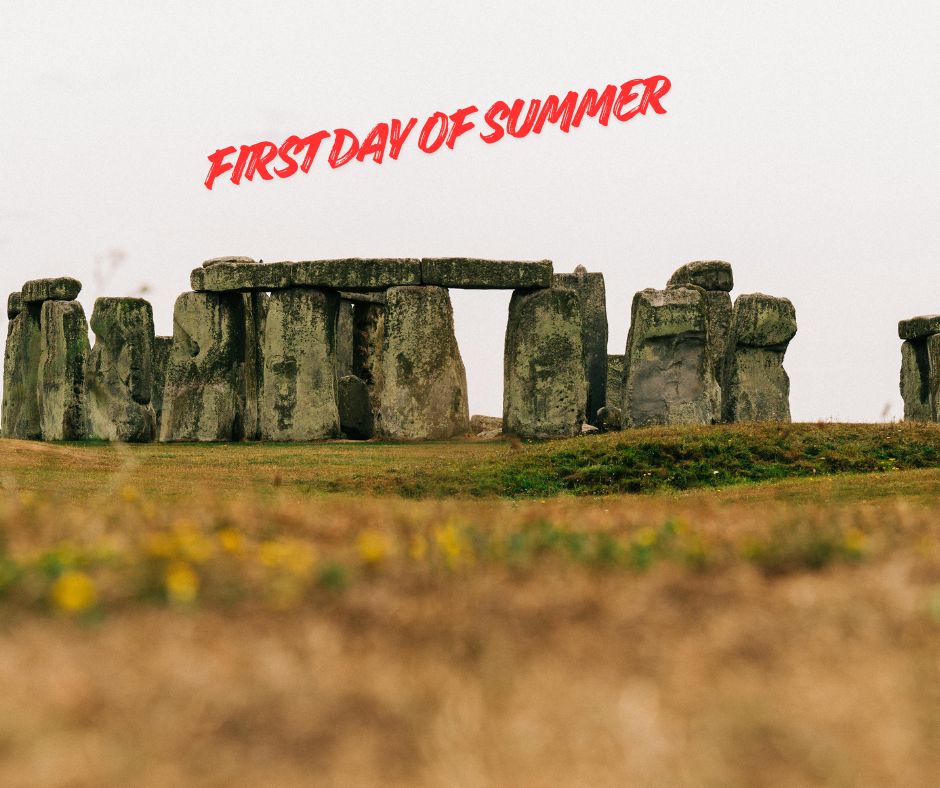
The first day of summer 2026 falls on Sunday, June 21, 2026, at 8:24 AM UTC (4:24 AM EDT). This astronomical event — the summer solstice — marks the moment Earth’s Northern Hemisphere reaches its maximum axial tilt toward the sun, producing the year’s longest period of daylight and shortest night.
This guide covers the exact solstice time across every major time zone, the orbital mechanics that cause it, the cultural and spiritual traditions observed worldwide, how to celebrate at every age, the rare Father’s Day overlap in 2026, travel trends emerging this summer, and a full seasonal calendar of sky events that follow.
Table of Contents
When Is the First Day of Summer 2026? Official Date and Exact Time
The summer solstice 2026 occurs on Sunday, June 21, 2026, at 8:24 AM UTC. The solstice is not an all-day event — it is a precise astronomical moment when the sun reaches its greatest solar declination of +23.5°, directly above the Tropic of Cancer.
Summer Solstice 2026 Time by Time Zone
The moment of the solstice is simultaneous worldwide. Local time differs by time zone.
| Time Zone | City | Solstice Time |
|---|---|---|
| UTC | Greenwich | Sunday, June 21 at 8:24 AM |
| EDT (UTC−4) | New York | Sunday, June 21 at 4:24 AM |
| CDT (UTC−5) | Chicago | Sunday, June 21 at 3:24 AM |
| MDT (UTC−6) | Denver | Sunday, June 21 at 2:24 AM |
| PDT (UTC−7) | Los Angeles | Sunday, June 21 at 1:24 AM |
| BST (UTC+1) | London | Sunday, June 21 at 9:24 AM |
| CET (UTC+2) | Paris / Berlin | Sunday, June 21 at 10:24 AM |
| MSK (UTC+3) | Moscow | Sunday, June 21 at 11:24 AM |
| IST (UTC+5:30) | Mumbai / New Delhi | Sunday, June 21 at 1:54 PM |
| CST (UTC+8) | Beijing / Shanghai | Sunday, June 21 at 4:24 PM |
| JST (UTC+9) | Tokyo | Sunday, June 21 at 5:24 PM |
| AEST (UTC+10) | Sydney | Sunday, June 21 at 6:24 PM |
The first day of summer 2026 is Sunday, June 21, 2026, at 8:24 AM UTC. In New York, the solstice occurs at 4:24 AM EDT. Summer ends at the autumnal equinox on Tuesday, September 22, 2026, making the 2026 astronomical summer 93 days long.
Does the Summer Solstice Always Fall on June 21?
No. The solstice date shifts between June 20 and June 21, depending on the Gregorian calendar cycle and the accumulation of leap years. The cause is the difference between Earth’s orbital period (approximately 365.25 days) and the fixed 365-day calendar year. Every four years, a leap day resets the drift.
The solstice fell on June 21 in 2026, but future dates shift as follows:
| Year | Solstice Date | Solstice Time (UTC) |
|---|---|---|
| 2026 | Sunday, June 21 | 8:24 AM |
| 2027 | Monday, June 21 | 2:11 PM |
| 2028 | Wednesday, June 20 | 7:02 PM |
| 2029 | Thursday, June 21 | 12:48 AM |
In rare cases — occurring roughly once per century — the solstice can fall on June 22. This will not happen again until 2203.
How Long Is Astronomical Summer 2026?
Astronomical summer 2026 spans 93 days, running from Sunday, June 21, 2026, through Tuesday, September 22, 2026, when the autumnal equinox returns the sun to the celestial equator. Summer is not the same length every year. Earth travels slightly faster near perihelion (closest point to the sun, occurring around January 3) and slightly slower near aphelion (farthest point, occurring around July 4). Because the Northern Hemisphere’s summer straddles aphelion, astronomical summer in the Northern Hemisphere is actually the longest of the four seasons by several days.
The Science Behind the First Day of Summer
The summer solstice occurs because Earth’s rotational axis is tilted at 23.5° relative to its orbital plane around the sun. This axial tilt does not change as Earth orbits. What changes is which hemisphere is tilted toward the sun.
Earth’s Axial Tilt and the Subsolar Point
On June 21, 2026, the subsolar point — the location on Earth’s surface where the sun stands directly overhead at solar noon — crosses the Tropic of Cancer at 23.5° North latitude. This is the sun’s maximum northern declination. After this date, the subsolar point begins its slow retreat southward toward the equator (September equinox) and eventually the Tropic of Capricorn (December solstice).
The sun does not rise and set at 90° east and west on the solstice. On June 21 at mid-latitudes, the sun rises noticeably north of due east and sets noticeably north of due west. At the Arctic Circle (66.5° North), the sun does not set at all — this is the midnight sun phenomenon.
Why the First Day of Summer Produces the Longest Day
The longest day occurs because the sun travels a longer arc across the sky on June 21 than on any other date. The sun rises earlier, reaches a higher solar noon altitude, and sets later. The angle and duration of sunlight together determine daylight hours.
Daylight duration on June 21, 2026, varies significantly by latitude:
| City | Country | Latitude | Daylight Hours (June 21) |
|---|---|---|---|
| Reykjavik | Iceland | 64.1°N | ~21 hours 8 minutes |
| Oslo | Norway | 59.9°N | ~18 hours 48 minutes |
| Helsinki | Finland | 60.2°N | ~18 hours 57 minutes |
| London | United Kingdom | 51.5°N | ~16 hours 38 minutes |
| Berlin | Germany | 52.5°N | ~16 hours 50 minutes |
| New York | United States | 40.7°N | ~15 hours 6 minutes |
| Los Angeles | United States | 34.1°N | ~14 hours 26 minutes |
| Miami | United States | 25.8°N | ~13 hours 45 minutes |
| Mexico City | Mexico | 19.4°N | ~13 hours 19 minutes |
| Accra | Ghana | 5.6°N | ~12 hours 10 minutes |
| Quito | Ecuador | 0.2°S | ~12 hours 6 minutes |
| Sydney | Australia | 33.9°S | ~9 hours 54 minutes (winter) |
Locations above the Arctic Circle (66.5°N) experience 24 continuous hours of daylight on June 21. Locations below the Antarctic Circle (66.5°S) experience 24 continuous hours of darkness.
Astronomical Summer vs. Meteorological Summer: Key Differences
These are two separate systems with different start dates and different purposes. Neither is more “correct” — they serve different disciplines.
| Feature | Astronomical Summer | Meteorological Summer |
|---|---|---|
| Start date (2026) | Sunday, June 21, 2026 | Monday, June 1, 2026 |
| End date (2026) | Tuesday, September 22, 2026 | Sunday, August 31, 2026 |
| Duration | 93 days | 92 days |
| Defined by | Earth’s position relative to the sun | Temperature cycles and calendar months |
| Used by | Astronomers, historians, cultural traditions | Meteorologists, climate scientists, weather services |
| Varies yearly | Yes (June 20–21 range) | No (always June 1–August 31) |
The meteorological definition exists for practical climate comparison. Monthly averages are easier to compute when seasons align with whole calendar months. The astronomical definition is the older system, rooted in celestial observation, and is what most cultures historically celebrated.
Why June 21 Feels Like Midsummer, Not the Start
This is the most common point of confusion. In many Northern European traditions, the solstice is called “Midsummer” — not the start of summer. That framing is meteorologically accurate. By June 21, temperatures in most of the Northern Hemisphere have already been rising for three to four weeks. Summer feels underway because it is, meteorologically.
The reason June 21 is the astronomical start is that Earth’s orbital mechanics define seasons by the sun’s position, not by air temperature. The temperature peak of summer typically lags 4–6 weeks behind the solar maximum — a phenomenon called thermal lag — because land and ocean take time to absorb and re-radiate solar energy. This is why the hottest weeks of summer in most Northern Hemisphere locations fall in mid-July to early August, not on June 21.
What “Solstice” Means
“Solstice” derives from the Latin sol (sun) and sistere (to stand still). The name describes the visual appearance of the sun’s northward movement, pausing before reversing south. For several days around June 21, the sun rises and sets at nearly the same point on the horizon. Ancient observers noticed this apparent stillness and marked it as a turning point in the year.
The sun does not literally stop moving. Its apparent halt is a function of the rate of change in solar declination approaching its maximum — the rate slows near the solstice extremes before accelerating again toward the equinoxes.
First Day of Summer 2026 and Father’s Day: A Rare Overlap
In 2026, Father’s Day and the summer solstice fall on the same date: Sunday, June 21, 2026. Father’s Day is observed on the third Sunday of June in the United States, Canada, the United Kingdom, and dozens of other countries. Because June 21 is both the third Sunday of June and the astronomical solstice, the two occasions coincide.
This overlap occurs occasionally but not on a fixed cycle. The previous alignment of Father’s Day and the solstice on the same date occurred in 2015. The next will occur in 2037.
Father’s Day + First Day of Summer 2026 Activity Ideas
The combination of the longest day and Father’s Day creates specific opportunities for outdoor, extended-daylight celebrations. Activities suited to both occasions include the following:
- Sunrise hike: Plan a pre-dawn drive to a high-elevation or open-horizon viewpoint. At 4:24 AM EDT, sunrise occurs by approximately 5:24 AM in the Northeast United States — early but manageable for the occasion.
- Backyard astronomy session: The solstice is followed by the Full Strawberry Moon on Monday, June 29, 2026. Set up a telescope on June 21 for a solar observation session (with certified solar filter equipment only) as a daytime activity.
- Solstice BBQ with sunset dinner: Sunset falls after 8:30 PM in most mid-latitude U.S. cities on June 21, creating a natural multi-hour outdoor window for afternoon to evening cookouts.
- Summer bucket list creation: A tradition growing on Pinterest and TikTok — creating a printed or handwritten “Summer Bucket List” as a shared family activity with dad as a Father’s Day keepsake.
- Stargazing kit gift: The 2026 Perseid Meteor Shower peaks August 11–12, 2026, during a nearly moonless phase — one of the best viewing years of the decade. A compact stargazing kit (red-light flashlight, star chart, portable chair) positioned as a Father’s Day gift activates across the full summer.
How Many Hours of Daylight Are There on the First Day of Summer 2026?
Daylight hours on June 21, 2026, range from approximately 9 hours 54 minutes in Sydney, Australia (winter solstice) to over 21 hours in Reykjavik, Iceland. At the equator, daylight is roughly 12 hours year-round. The variation is produced entirely by latitude and Earth’s axial tilt.
The table in the preceding science section provides precise figures by city. Key reference points:
- Arctic Circle and above: 24 continuous hours of daylight (midnight sun)
- 60°N (Oslo, Helsinki): 18–19 hours of daylight
- 51°N (London): approximately 16 hours 38 minutes
- 40°N (New York, Madrid): approximately 15 hours
- 25°N (Miami, Riyadh): approximately 13 hours 45 minutes
- Equator: approximately 12 hours 6 minutes
- Southern Hemisphere: decreasing daylight as latitude increases southward
Global Traditions on the First Day of Summer 2026
The summer solstice is one of the most widely observed astronomical events in human history, with documented celebrations on every inhabited continent. The specific traditions differ significantly by region, religion, and cultural heritage.
Stonehenge Summer Solstice 2026 (Wiltshire, England)
Stonehenge in Wiltshire, England, is the most recognized solstice site in the world. The monument’s Heel Stone aligns with the midsummer sunrise, channeling sunlight through the central axis of the sarsen circle. English Heritage estimates that 10,000–13,000 people attend the annual free public access solstice event at Stonehenge. The sunrise on June 21, 2026, occurs at approximately 4:52 AM BST at Stonehenge’s latitude (51.2°N).
Stonehenge’s solstice alignment was deliberate. Archaeoastronomical research published by English Heritage and Clive Ruggles (University of Leicester) confirms that the monument’s orientation matches the June solstice sunrise and the December solstice sunset — a dual alignment. Construction began approximately 5,000 years ago and continued in phases over 1,500 years.
Visitors attend the event free of charge but must register in advance through English Heritage’s official access program. The site opens for the all-night vigil at 7:00 PM on June 20, 2026.
Midsommar 2026 (Sweden)
Sweden’s Midsommar is the country’s second most important holiday after Christmas, celebrated on the Saturday between June 20 and 26. In 2026, Midsommar falls on Saturday, June 20, the day before the astronomical solstice. The celebration centers on the raising of the midsommarstång (maypole), communal dancing, flower crown weaving, and a traditional menu of pickled herring (inlagd sill), new potatoes with dill, and strawberries with cream.
The Swedish Midsommar is not officially tied to the astronomical solstice moment — it follows a fixed calendar rule (Saturday between June 20 and 26) established by the Swedish parliament. In some years, this produces a gap of several days between the holiday and the actual solstice; in 2026, the gap is one day.
Litha: Pagan and Wiccan Summer Solstice Observance
Litha is one of eight seasonal festivals — “sabbats” — on the Wheel of the Year observed in Wiccan and contemporary Pagan traditions. The name “Litha” may derive from the Old English term for the months surrounding the solstice, referenced in Bede’s 8th-century work De Temporum Ratione. Litha marks the sun’s peak power before its gradual decline toward winter.
Common Litha observances include: lighting bonfires at sunset on June 20 or sunrise on June 21, gathering herbs (St. John’s Wort, lavender, vervain), making flower wreaths, setting seasonal intentions, and outdoor ritual at dawn. The tradition is not monolithic — practices vary significantly between Wiccan traditions, Druidic groups, and broader contemporary Pagan communities.
Jāņi 2026 (Latvia)
Jāņi is Latvia’s national midsummer festival, observed on June 23–24, and designated a national holiday. It is one of the most significant cultural events in the Latvian calendar. Traditions include: wearing oak-leaf garlands (for men) and flower crowns (for women), singing traditional dainas (folk songs), lighting bonfires (Jāņu ugunis), eating Jāņu siers (a caraway-spiced cheese), and staying awake through the entire short night. The Latvian word “Jānis” corresponds to the Christian feast of Saint John the Baptist (June 24), and the festival merges pre-Christian Latvian solar traditions with the Christian calendar date.
Jāņi is inscribed on the UNESCO Intangible Cultural Heritage list as part of the broader “Baltic Song and Dance Celebration” heritage.
Ivan Kupala Night (Eastern Europe)
Ivan Kupala Night is observed on the night of July 6–7 in countries following the Julian calendar, and on June 23–24 in countries following the Gregorian calendar. It is celebrated primarily in Russia, Ukraine, Belarus, and Poland.
The festival combines Slavic pre-Christian midsummer traditions with the Christian feast of John the Baptist (Ivan being the Slavic form of John).
Traditions include: leaping over bonfires (believed to bring health and good fortune), floating flower wreaths on rivers, ritual bathing in rivers or lakes, and searching for the mythical flowering fern (a folk element without botanical basis — ferns do not flower). The water and fire elements reflect the festival’s origins as a celebration of seasonal fertility and solar power.
Inti Raymi 2026 (Cusco, Peru)
Inti Raymi — the Festival of the Sun — is held annually on June 24 in Cusco, Peru, and is one of the most attended cultural events in South America. It was the most important festival in the Inca calendar, honoring Inti, the sun deity. The Spanish colonial government banned it in 1572. It was revived in 1944 by Faustino Espinoza Navarro based on historical chronicles, and is now a major cultural and tourism event drawing an estimated 100,000 visitors annually to Cusco.
The festival occurs at three sites: Qorikancha (the Temple of the Sun), the Plaza de Armas, and the Sacsayhuamán archaeological complex. The June 24 date reflects the Inca calendar’s relationship to the solstice — June 21 in the Northern Hemisphere calendar corresponds to the winter solstice in the Southern Hemisphere, which the Inca associated with the sun’s rebirth.
Juhannus (Finland)
Juhannus is Finland’s midsummer celebration, observed on the Saturday between June 20–26, coinciding with Midsommar in Sweden. Finland officially designates Juhannus as a public holiday. Traditions include cottage stays in the Finnish lakeland or archipelago, bonfire lighting (kokko), sauna bathing at lakeside, and for many Finns, consumption of sima (a light fermented mead). The celebration draws heavily from Finnish folk tradition and connects strongly to the natural environment — approximately 70% of Finland’s population relocates to rural areas or cottage properties for the Juhannus weekend.
How to Celebrate the First Day of Summer 2026
First Day of Summer Activities for Kids
The following activities are suited for children ages 3–12 and require minimal preparation:
- First-day-of-summer photo board: A widely shared Pinterest and Instagram tradition — create a chalkboard or printed sign with prompts (“favorite food,” “favorite summer activity,” “what I want to be when I grow up”) and photograph children holding it annually.
- Sun science experiments: Demonstrate the sun’s angle using a gnomon (a vertical stick in soil) and measure its shadow at solar noon. Compare the shadow length to the winter solstice equivalent using photographs.
- Summer bucket list creation: Print a blank bucket list template and fill it in as a family. Research shows children who set explicit seasonal goals report higher satisfaction with school-break activities (University of Minnesota Center for Applied Research in Education, 2021).
- Water activities: Sprinkler runs, water balloon activities, and homemade water slides on grass are well-suited to the extended daylight of June 21.
- Solstice nature walk: Focus on identifying heliotropic plants — species that orient toward the sun, including sunflowers (Helianthus annuus) and marigolds (Tagetes spp.).
First Day of Summer Activities for Adults
The adult lifestyle segment is significantly underserved in summer solstice content. The following activities target solo, couple, and group adult audiences:
- Sunrise viewing: June 21 sunrise times range from approximately 4:52 AM BST in London to 5:24 AM EDT in New York to 5:44 AM PDT in Los Angeles. Public parks, coastlines, and unobstructed east-facing hilltops are optimal.
- Outdoor yoga or sun salutations: Surya Namaskar (sun salutation) sequences are specifically calibrated to the sun’s arc and are performed by practitioners globally at solstice sunrise.
- Solstice bonfire: Legal open fire sites — designated fire pits, private land, campgrounds — allow bonfire ceremonies aligned with European and North American folk traditions. Check local burning restrictions before lighting.
- Moonlight hiking: The Full Strawberry Moon on Monday, June 29, 2026, is 8 days after the solstice. Plan a moonlit hike for June 29–30 to extend the celestial theme.
- Circadian rhythm reset: The longest natural light day of the year is an opportunity to reset sleep-wake cycles. Exposure to bright natural light before 8:00 AM on June 21 advances the circadian phase, documented in research published in the Journal of Biological Rhythms (Khalsa et al., 2003). Avoiding artificial light after 9:00 PM that evening extends the reset effect.
First Day of Summer Wellness and Morning Routine
A structured morning routine on June 21 that leverages peak natural light can advance circadian rhythm calibration for the broader summer season. The following sequence is based on chronobiology research:
- Wake before sunrise (target: 30 minutes before local sunrise). Darkness prior to dawn light exposure primes the suprachiasmatic nucleus for the incoming light signal.
- Outdoor light exposure within 10 minutes of waking. Morning sunlight suppresses melatonin and triggers cortisol release. Even 10–15 minutes of outdoor exposure without sunglasses is sufficient, according to research by Dr. Andrew Huberman (Stanford Neuroscience, 2021).
- Physical movement outdoors. Walking, running, or yoga within the first hour leverages the thermogenic and cortisol-aligned state of the morning.
- Delay caffeine intake by 90–120 minutes post-waking to allow the natural adenosine clearance cycle to operate before caffeine’s adenosine-blocking effect is introduced (per Dr. Matthew Walker, Why We Sleep, 2017).
- Eat a protein-forward breakfast before 9:00 AM. Protein at the first meal stabilizes blood glucose and supports dopamine synthesis, relevant to the mood elevation associated with increased sun exposure.
Summer Solstice 2026 Travel Trends: Coolcations and Midnight Sun
The dominant 2026 summer travel trend is the “coolcation” — intentional travel to cooler, high-latitude destinations to escape record-breaking heat in traditional summer destinations.
A 2024 Booking.com Sustainable Travel Report found that 43% of global travelers actively considered heat when selecting summer destinations, up from 28% in 2022. This trend has accelerated into 2026 travel planning cycles.
Top Coolcation Destinations for June 2026
High-latitude destinations that offer the midnight sun, lower temperatures, and solstice-specific cultural events include the following:
| Destination | Country | Average June Temp. (°C) | Midnight Sun Dates | Solstice Attraction |
|---|---|---|---|---|
| Tromsø | Norway | 10°C | May 20 – July 22 | Midnight Sun Marathon (June 20) |
| Reykjavik | Iceland | 11°C | May 21 – July 24 | Secret Solstice Festival (June 19–22) |
| Rovaniemi | Finland | 14°C | June 6 – July 7 | Juhannus celebrations |
| Luleå | Sweden | 15°C | June 4 – July 9 | Midnight Sun golf, kayaking |
| Fairbanks | Alaska, USA | 16°C | May 17 – July 27 | Midnight Sun Festival (June 20–22) |
Reykjavik’s Secret Solstice Festival runs from Thursday, June 19, 2026, through Sunday, June 22, 2026. The festival features performances inside the Langjökull glacier, midnight sun concerts, and geothermal pool events. Ticket categories range from day passes to full festival passes.
The 2026 Sleeper Train Renaissance
European sleeper train routes have expanded significantly since 2022, and summer 2026 marks the peak of this renaissance. Nightjet (Austrian Federal Railways), European Sleeper, and Snälltåget now operate overnight routes connecting major Central European cities with Scandinavia and the Iberian Peninsula.
Travelers depart on the evening of June 20, arriving at a coolcation destination on the morning of June 21 — beginning the solstice day in a new country.
Routes relevant to June 21, 2026, solstice travel include: Vienna to Hamburg (Nightjet), Brussels to Berlin (European Sleeper), and Stockholm to Hamburg (Snälltåget summer schedule). Book 60–90 days in advance; June 20–21 dates are in high demand.
Sky Events Following the First Day of Summer 2026
The solstice marks the beginning of the richest astronomical viewing period of the Northern Hemisphere year. Events in the 90 days following June 21, 2026, include the following:
Full Strawberry Moon 2026
The Full Strawberry Moon falls on Monday, June 29, 2026, 8 days after the solstice. The name originates from the Algonquin, Ojibwe, and Cree nations of North America, referencing the strawberry harvest season. The Old Farmer’s Almanac documented this naming tradition in its earliest editions; the name has been in continuous use since at least the 18th century.
Because the solstice is the highest-sun period and the full moon is geometrically opposite the sun, the Strawberry Moon rises low on the southern horizon and appears amber or orange. This color effect is caused by atmospheric refraction — moonlight traveling through more atmosphere at low angles scatters short-wavelength (blue) light, leaving the longer red and orange wavelengths dominant.
Earth at Aphelion: Saturday, July 4, 2026
Earth reaches aphelion — its farthest point from the sun, approximately 152.1 million kilometers — on Saturday, July 4, 2026. This is the annual maximum in Earth-Sun distance. Despite common assumptions, Earth is not hotter in summer because it is closer to the sun. It is warmer because the Northern Hemisphere is tilted toward the sun at a higher angle, producing more direct and prolonged radiation, not because of reduced distance. At aphelion, Earth travels slightly slower in its orbit than at perihelion, which is part of why Northern Hemisphere summers are longer than Northern Hemisphere winters.
Perseid Meteor Shower 2026: Peak August 11–12
The Perseid Meteor Shower peaks on the night of Tuesday, August 11, 2026, through the morning of Wednesday, August 12, 2026. The 2026 Perseids occur during a waning crescent moon phase, producing nearly moonless skies at peak activity — one of the most favorable viewing conditions in a decade.
The Perseids are debris from Comet 109P/Swift-Tuttle. Earth passes through the debris stream annually from approximately July 14 to August 24. At peak, experienced observers under dark skies record 50–100 meteors per hour. The shower’s radiant point is in the constellation Perseus (northeast sky), but meteors appear across the full sky.
To observe: find a location with minimal light pollution (Bortle Class 1–3 preferred), allow 20–30 minutes for dark adaptation, and observe between midnight and 4:00 AM local time for the highest meteor rates.
Autumnal Equinox 2026: Tuesday, September 22
Astronomical summer ends at the autumnal equinox on Tuesday, September 22, 2026. On this date, the sun crosses the celestial equator moving southward, and day and night approach equal duration globally. The exact equinox time will be confirmed by the United States Naval Observatory closer to the date.
The 2026 FIFA World Cup and Summer Solstice: June 21 Match Schedule
The 2026 FIFA World Cup opens on Thursday, June 11, 2026, and the group stage continues through Sunday, June 28, 2026. Sunday, June 21, 2026 — the summer solstice — falls during an active match day in the group stage. Host cities span three countries: Canada, Mexico, and the United States.
This overlap creates a specific cultural context for June 21, 2026, that is absent from any recent solstice year. For much of North America and Europe, the solstice will be experienced simultaneously as an astronomical event and a major live sports occasion.
Key considerations for June 21, 2026, at World Cup venues:
- SoFi Stadium (Inglewood, California): Fully enclosed retractable roof; kick-off times adjusted to avoid the afternoon peak heat of 32–36°C typical in the Los Angeles basin in late June.
- Estadio Azteca (Mexico City, Mexico): Open bowl at 2,240 meters elevation. Afternoon matches begin at approximately 3:00 PM local MDT. Solar noon on June 21 in Mexico City is approximately 1:24 PM — the sun will be at near-maximum altitude during early afternoon kick-offs.
- BC Place (Vancouver, Canada): Retractable roof stadium; June 21 afternoon temperatures in Vancouver average 21°C, making outdoor fan zones comfortable through the evening.
Fan festivals in all 16 host cities operate through the solstice evening, extending the longest day into some of the largest outdoor cultural gatherings North America will host in 2026.
Frequently Asked Questions About the First Day of Summer 2026
When is the first day of summer 2026?
Sunday, June 21, 2026, at 8:24 AM UTC. Local times: 4:24 AM EDT (New York), 9:24 AM BST (London), 10:24 AM CET (Paris). Summer ends Tuesday, September 22, 2026, at the autumnal equinox.
What is the difference between astronomical and meteorological summer?
Astronomical summer begins at the solstice (June 21, 2026) and ends at the autumnal equinox (September 22, 2026). Meteorological summer runs from June 1 through August 31, based on temperature cycles. Meteorologists use the fixed June–August window for consistent climate data comparison. Astronomers and most cultural traditions use the solstice-based definition.
Why does the solstice feel like the middle of summer, not the start?
Thermal lag. Land surfaces and ocean water absorb solar energy over weeks before releasing it as heat. By June 21, three to four weeks of increasing solar radiation have already warmed the Northern Hemisphere. The hottest weeks of summer typically occur 4–6 weeks after the solstice — in mid-July to early August — not on the solstice itself.
Does Father’s Day coincide with the summer solstice in 2026?
Yes. Father’s Day (third Sunday of June) falls on Sunday, June 21, 2026, the same date as the summer solstice. This overlap last occurred in 2015 and will next occur in 2037.
What is the Strawberry Moon 2026?
The Full Strawberry Moon of 2026 falls on Monday, June 29, 2026, 8 days after the solstice. The name originates from Indigenous North American nations, referencing the strawberry harvest season. The June full moon rises low on the horizon and frequently appears amber or orange due to atmospheric refraction.
When is the first day of summer in the Southern Hemisphere?
The Southern Hemisphere’s first day of summer falls on Sunday, December 21, 2026. June 21 is the Southern Hemisphere’s winter solstice — the shortest day of the year for countries including Australia, New Zealand, South Africa, Brazil, and Argentina. Sydney, Australia, receives approximately 9 hours 54 minutes of daylight on June 21, 2026.
What is Litha?
Litha is the Pagan and Wiccan name for the summer solstice, observed as one of eight seasonal sabbats on the Wheel of the Year. It marks the sun’s peak power before its gradual decline toward winter. Practices include dawn bonfires, herb gathering (specifically St. John’s Wort, lavender, and vervain), flower wreaths, and setting intentions for the second half of the solar year.
How does the 2026 solar cycle affect the solstice?
Solar Cycle 25, which began in December 2019, is projected to reach its solar maximum in 2025–2026. During solar maximum, increased sunspot activity and solar flares can affect HF radio communications, GPS accuracy, and satellite operations — particularly during geomagnetic storm events. The solstice itself is not affected by the solar cycle, but space weather events are more frequent and intense during this period. NOAA’s Space Weather Prediction Center monitors geomagnetic activity in real time at swpc.noaa.gov.